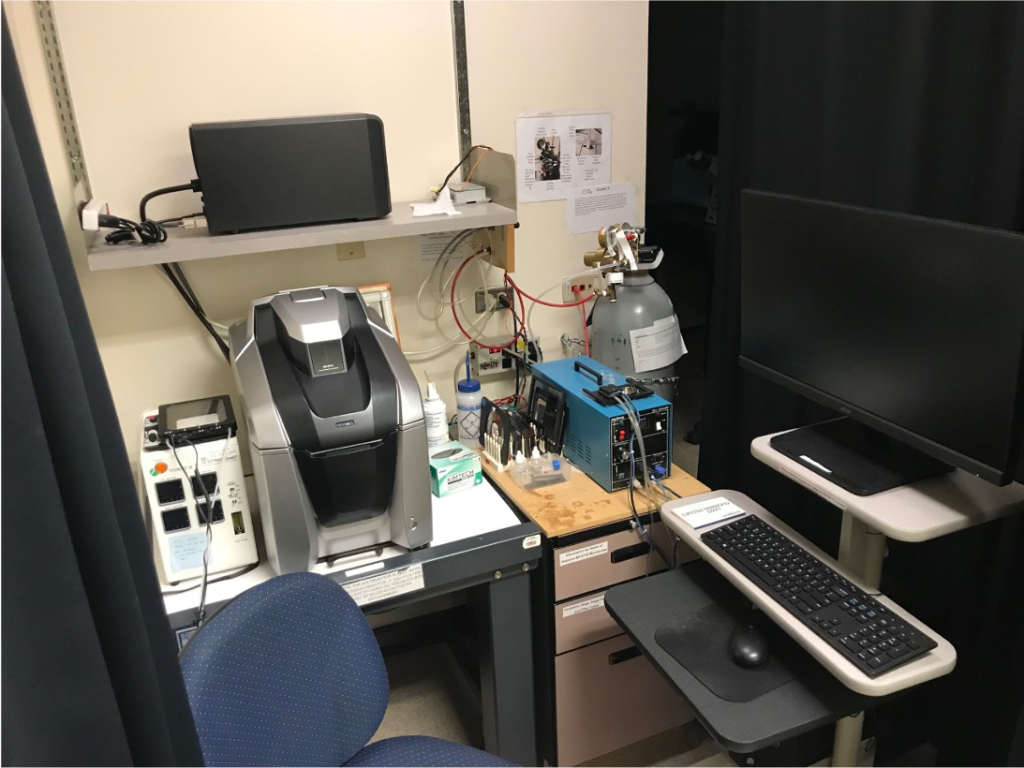
Location: Room 224 Molecular and Radiological Biosciences (MRB) Building
Both the BZ-X 710 and BZ-X 810 microscopes have fully enclosed stage chambers that allow all imaging to be done under normal room lighting conditions. Both microscopes are under computer mouse control for X,Y,Z stage position, focus, filter cube selection, and turret objective switching. Objectives: the 710 has plan apo 2x, 10x, 20x, 40x air, 100x oil, and 40x long working distance phase contrast; the 810 has plan apo 4x, 10x, 20x, 40x air and 63x oil. Image capture from center or corner of a viewing area can be set for field numbers between 2×2 to 29×29 and can automatically focus and capture images at up to 3 wavelengths (and an overlay) within the mapped area from slides, culture dishes or microtiter plates. Within each field it is also possible to capture a z-stack (0.1 μm minimum step size) to build 3D images of samples up to 500 microns thick. A full focus (projection) image or a 3D viewable stack can be created from these. Optical sectioning (aka structured illumination) on the 710 can be used to acquire the image stack (9 images with different grid orientations to obtain one SIM field) to improve resolution to confocal quality. Stitched arrays are easily created manually (30 sec) from the single array images using the Keyence Analyzer Stitching program, but free software programs are available at github for automated stitching of large numbers of image arrays from the BZ-X810. Filter cubes (4) are easily switched during observations without the need to turn off the light. Standard configuration has DAPI (405 nm), GFP (488 nm), mRFP (561 nm) and an open position for brightfield. Other cubes are available for YFP (515 nm), Cy5/iRFP (640 nm) and NeuO, a neuronal viability stain that is excited at 488 and emits at >620 nm. The 710 utilizes a white metal halide lamp (2000 working hours) while the 810 uses white LED lighting (40,000 hs). In brightfield mode, oblique illumination achieves DIC image quality. Tokai-Hit stage incubators for temperature, CO2, and humidity control are on both systems. The Keyence can obtain stacks through 500 µm thick slices. The units have high sensitivity cooled monochrome CCD (fluorescence or oblique illumination imaging) that is converted at the click of a button to a CCD 3 color camera for dye-stained tissue slices. A large, motorized stage, high-speed autofocus, low photobleaching mode and real-time image overlays are features of both microscopes. The 810 has a greater stage movement to image full areas of all wells at 20X on microtiterplates. High resolution (single pixel), standard resolution (2×2 binning) and high sensitivity (3×3 binning) are selected by a mouse click. Advanced imaging functions include image stitching, navigation (maintains image of montage on side panel and lets you see where you are located as you change objectives for higher magnification), optical sectioning (710), or time-lapse.
A Peltier heated/cooled stage adapter (-20+ C to +60+ C) is available for use on these microscopes (see ancillary equipment).
Analysis software (710) includes hybrid cell counts to automatically quantify the % of cells expressing tags, color extraction (for stained sections) and masking functions.
For Training and use of this equipment contact: Alisa Shaw (alisa.shaw@colostate.edu)
Cost:
Training: $40
Hourly: $5 for first hr, $1/hr thereafter.